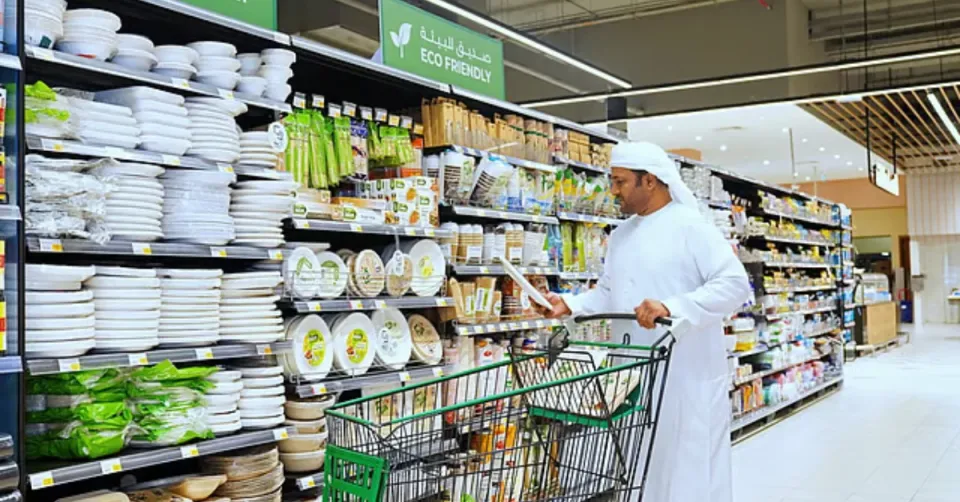
Major UAE retailers are rolling out eco-friendly alternatives across their stores as Dubai Municipality intensifies enforcement of the final phase of its single-use plastics ban, set to take full effect from January 1, 2026, coinciding with the enforcement of Cabinet Resolution No. (380) of 2022 regulating the use of single-use products across UAE markets.
Supermarket chains are replacing plastic cups, cutlery, plates, straws and Styrofoam containers with paper-based, biodegradable and reusable options, in line with Dubai Executive Council Resolution No. (124) of 2023.
Retailers confirmed to Gulf News that Dubai Municipality, which has issued guidelines on the ban, has already begun asking them to remove several single-use products from the shelves, reflecting the Government of Dubai’s commitment to advancing the UAE’s circular economy and Net Zero 2050 objectives.
Transition well underway
V Nandakumar, director of marketing and communications at Lulu Group, said the group has proactively started discontinuing the sale of single-use plastic products. “We have introduced many varieties of eco-friendly, reusable products including recycled paper products, which are very good replacements for these kinds of single-use plastic products, and we already are seeing good appetite and demand from consumers,” he said.
Lulu has also started begun displaying sustainable products in separate sections. “Our goal is to incorporate eco-friendly product sections among all our hypermarkets so that consumer has greater choices. We are seeing tremendous acceptability by the shoppers, and we also do many awareness campaigns through our social media pages, as well as through promotion campaigns to incentivise the use of these reusable bags,” Nandakumar added.
Responsible consumption
Mussaab Aboud, chief executive officer of Grandiose, said the retailer began phasing out single-use plastic checkout bags in 2018. “Now, shoppers will see a constant, well-managed transitions designed to support responsible consumption without disruption. Items such as plastic cups, lids, cutlery, straws, and Styrofoam food containers will be replaced with certified compostable, paper-based, or reusable alternatives, in line with Dubai Municipality guidelines.”
Alongside packaging changes, he said they have also introduced shopping trolleys made from recycled ocean plastic, “helping cut emissions by up to 80%, and replaced conventional PET materials with rPET and PLA (plant-based) alternatives as part of our broader transition.”
Price impact?
Kamal Vachani, deputy CEO and group partner at Al Maya Group, said the banned items are being replaced with approved alternatives including paper and bagasse-based packaging, biodegradable or wooden cutlery, and reusable options.
While some sustainable alternatives may carry a slightly higher cost, he said, retailers are making every effort to keep prices reasonable. “As availability increases, price differences are expected to narrow,” he said.
Dr Dhananjay Datar, chairman and managing director of Al Adil Group, echoed this view. “There may be a marginal cost difference for certain sustainable packaging solutions; however, we are making every effort to absorb these costs wherever possible. Our objective is to ensure that sustainability does not become a burden for consumers, especially for daily essentials,” he said.
Aboud said Grandiose aims to absorb costs by leveraging operational efficiencies. “We do not see sustainability as a premium add-on. Instead, we view it as part of delivering long-term value, trust, and resilience,” he said.
What’s being replaced
The ban covers beverage cups and lids, plastic cutlery, plates, straws, drink stirrers and Styrofoam food containers. These are being replaced with certified compostable, paper-based or wooden alternatives, including bagasse-based packaging, biodegradable cutlery and plant-fibre straws.
Datar noted that suppliers are shifting to biodegradable, compostable or paper-based packaging, especially for staples, grains and fresh produce. “We have been gradually reducing our dependence on single-use plastics and transitioning to eco-friendly alternatives to ensure a smooth experience for our customers…This transition is a collective effort. When retailers, consumers and authorities work together, sustainability becomes achievable,” he said.
Retailers are also running in-store awareness initiatives and deploying trained staff to guide shoppers towards eco-friendly options, ensuring the transition supports the UAE’s long-term environmental vision.
Packaging industry prepared
Products using recycled content manufactured within the UAE are among the exemptions, a provision aimed at supporting domestic recycling and local manufacturing capabilities, said a local manufacturing company.
Abdul Jebbar PB, group CEO and managing director of Hotpack, said the regulatory framework provides long-term direction for the packaging sector. “The UAE’s sustainability policies set a clear pathway for manufacturers and retailers alike. Packaging solutions are increasingly focused on closed-loop systems, particularly products that can remain within the recycling ecosystem though recycled raw materials cost more than virgin materials.”
“Manufacturers have been preparing for the transition well ahead of the enforcement timeline. Over the past decade, we have invested in research, development, and advanced manufacturing technologies that enable the use of recycled polymers, including materials with recycled content of up to 100 per cent. This has allowed us to align product portfolios with the forthcoming requirements.”
He said the company does not manufacture EPS products. “Instead, alternatives using materials such as H-PET and H-rPET have been developed, reducing material usage by up to 30 per cent while maintaining recyclability and functional performance,” he said.
The alternative packaging solutions manufactured by the company include those based on recycled polymers as well as paper and board, aluminium, moulded fibre, plant-based materials, and other biodegradable or compostable substrates. Multi-use and re-washable packaging formats have also been developed for sectors such as hospitality and food services.
News Courtesy: Gulfnews