Giant Wheat Starch Granules: A Biotech Breakthrough with Transformative Industrial Potential
Scientists have successfully developed wheat containing exceptionally large starch granules, marking a significant advancement in plant biotechnology. The breakthrough, achieved by researchers from the John Innes Centre, could pave the way for healthier food products while creating new opportunities across a wide range of manufacturing industries, including paper, pharmaceuticals, cosmetics, textiles, packaging, and biochemicals.
A New Generation of Wheat Starch
Starch is one of the most important carbohydrates in the human diet, providing up to half of the calories consumed worldwide. In cereal crops such as wheat, starch is stored as two distinct types of granules: large, disc-shaped A-type granules and much smaller, spherical B-type granules.
The size of these granules plays an important role in determining how quickly starch is digested. Larger granules have a lower surface-area-to-volume ratio, making them less accessible to digestive enzymes. As a result, they are broken down more slowly, increasing the amount of resistant starch that reaches the lower digestive tract.
Resistant starch functions similarly to dietary fibre, supporting a healthy gut microbiome while helping reduce rapid spikes in blood glucose levels that are commonly associated with refined carbohydrates. Researchers also believe that larger starch granules may improve the texture and quality of foods such as bread and pasta.
Solving a Long-Standing Scientific Challenge
Although scientists have long recognized the advantages of larger starch granules, the biological mechanisms controlling their size remained poorly understood.
To overcome this challenge, researchers led by the Seung Group at the John Innes Centre focused on durum wheat—the variety primarily used to produce pasta. Their objective was to determine which factors restrict starch granule growth and whether those limits could be removed through plant breeding.
The team identified two major biological constraints. The first was the limited space available inside the amyloplast, the plant cell structure where starch accumulates. The second was the large number of starch granules competing for the same supply of nutrients during development.
By increasing the storage capacity of the amyloplast while simultaneously reducing the number of granules formed, the researchers enabled the remaining granules to grow far larger than previously observed in cereal crops.
Record-Breaking Starch Granules
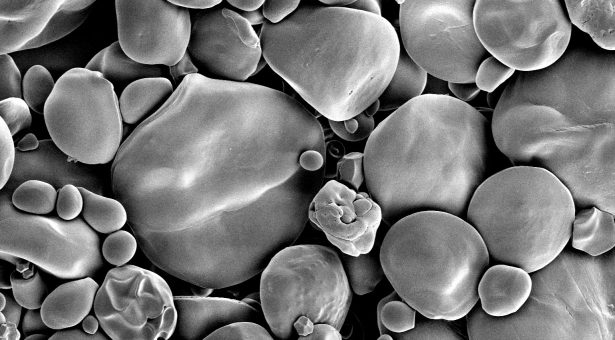
Scanning Electron Microscopy confirmed the remarkable results. The engineered wheat produced A-type starch granules measuring up to 50 micrometres in diameter—more than double the typical size of approximately 20 micrometres found in conventional wheat.
More than half of the granules measured around 30 micrometres, compared with only about six percent in standard wheat varieties. The unprecedented increase even required researchers to adjust their particle-size analysis equipment to accurately measure the enlarged granules.
Rose McNelly, the study’s first author, said the results exceeded the team’s expectations. While the researchers anticipated larger granules after removing the biological constraints, they were surprised by the extent of the increase.
Traditional Breeding, Not Genetic Modification
One of the notable aspects of the research is that the wheat was developed using traditional plant breeding techniques rather than genetic modification.
The team utilised a TILLING mutant population maintained at the John Innes Centre to identify plants carrying beneficial mutations in two genes responsible for amyloplast size and starch granule initiation. By cross-breeding these plants, they successfully combined both desirable characteristics into a single wheat variety.
Because naturally occurring wheat varieties show very little variation in starch granule size, this carefully targeted breeding strategy was essential for achieving such dramatic results.
Health Benefits Under Investigation
The research now moves beyond laboratory success toward practical food applications. Scientists from the John Innes Centre are collaborating with researchers at the Quadram Institute to produce pasta made from the newly developed wheat and evaluate its effects in human dietary studies.
The team hopes the larger starch granules will digest more slowly, helping reduce post-meal blood sugar spikes while increasing resistant starch levels that support beneficial gut bacteria. If confirmed, these properties could contribute to healthier cereal-based foods suitable for people seeking improved metabolic health.
Researchers also believe the same approach could eventually be applied to bread wheat, expanding the technology’s benefits to a much wider range of everyday foods.
Industrial Opportunities Beyond Food
The breakthrough extends well beyond nutrition. Starch is an essential raw material in numerous manufacturing industries, and larger granules offer several processing advantages.
In paper manufacturing and packaging, larger starch granules are easier to separate during production, improving process efficiency. They can also enhance binding, coating, and thickening performance in applications such as pharmaceuticals, cosmetics, adhesives, textiles, and specialty biochemicals.
As industries continue to seek sustainable, plant-based raw materials with improved functionality, the ability to engineer starch granule size could unlock entirely new commercial possibilities.
A Foundation for Future Innovation
The study demonstrates how fundamental research into plant biology can deliver practical innovations with broad societal impact. By uncovering the biological mechanisms that determine starch granule size, the researchers have opened new pathways for improving both human nutrition and industrial manufacturing.
While further testing is needed to confirm the health benefits in humans, the discovery represents an important proof of concept. It highlights the potential of precision plant breeding to develop crops that not only produce better food but also provide more versatile and valuable materials for multiple industries.
As research continues, giant wheat starch granules could become a key innovation at the intersection of agriculture, biotechnology, food science, and industrial manufacturing.